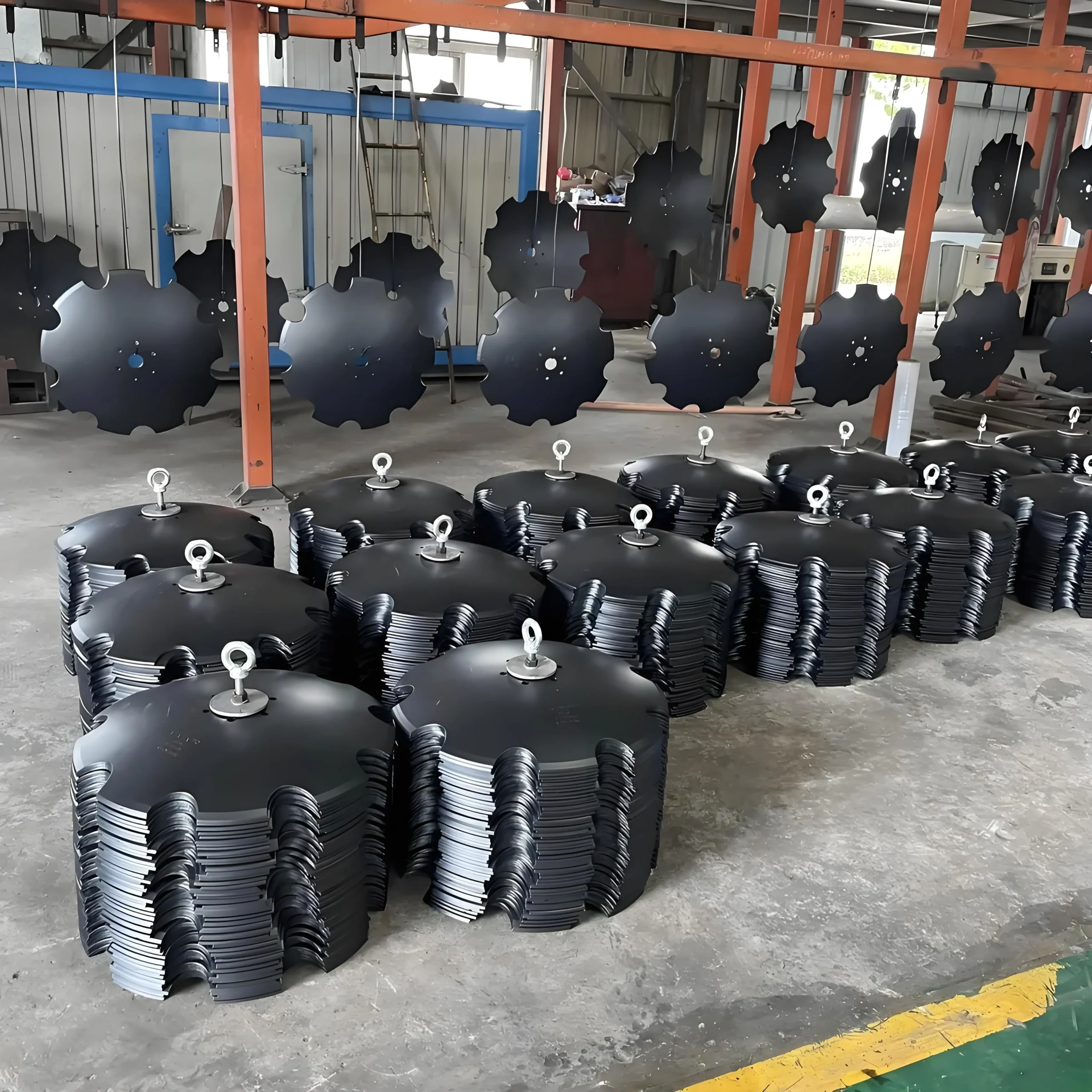
Disc harrow blades are the core components in agricultural land preparation operations. They are widely used in conjunction with disc harrows and combined land preparation machines, mainly responsible for soil breaking, tilling, stubble removal, and land reclamation. Their performance directly affects the subsequent sowing quality and crop emergence rate. Whether for large – scale farms or small and medium – sized growers, choosing the right harrow blades can significantly improve land preparation efficiency and reduce operating costs.
Common Types of Disc Harrow Blades
Based on the operating scenarios and structures, disc harrow blades are mainly classified into the following categories:
- Full – edge disc harrow blades (smooth disc harrow blades): The most commonly used basic type. With a smooth and complete cutting edge, they are mainly used for regular soil breaking and stubble removal in cultivated land. They are suitable for loam and sandy loam soils, and can result in a higher level of soil flatness after operation.
- Notched disc harrow blades (wavy – notched disc harrow blades): With notches on the edge, they have a stronger cutting ability. They are particularly suitable for clearing stubble and breaking up hard soil clods, and are more efficient in scenarios such as land reclamation of grasslands and straw return to the field.
- Corrugated disc harrow blades: The surface has transverse corrugations, which can increase the soil – breaking ability and reduce soil adhesion. They are suitable for land preparation in heavy and wet clay soils, and can break up the soil more evenly.
- Heavy – duty disc harrow blades: Specifically designed for deep loosening of the soil and land reclamation. They are thicker and heavier, and can be used with large – scale combined land preparation machines. They can penetrate hard soil layers up to 15 – 20 centimeters deep.
- Light – duty disc harrow blades: Suitable for small and medium – sized harrows. They are mainly used for shallow tillage before sowing. With low operating resistance, they are more suitable for matching with small agricultural machinery.
How to Choose the Right Material?
The service life and operating ability of disc harrow blades are mainly determined by the material. Currently, there are three mainstream materials commonly used:
- 65Mn spring steel: The most classic and commonly used material. It has good toughness, moderate hardness, and strong impact resistance. It is not easy to crack or deform, and can meet the needs of regular cultivated land operations. It offers high cost – effectiveness and is the preferred choice for most dealers and farmers.
- 60Si2Mn spring steel: A silicon – manganese alloy material. It has better strength and wear resistance than 65Mn, and superior high – temperature tempering performance. It is suitable for long – term and high – frequency operations and is a commonly used material for heavy – duty disc harrow blades. Its service life is longer than that of ordinary 65Mn harrow blades.
- Boron steel: By adding boron, its hardenability is improved. The overall hardness is higher, the cutting edge is sharper and more wear – resistant, and it also maintains good toughness. It performs excellently in land reclamation scenarios with rocky and hard soils. Although the price is relatively high, the overall long – term cost is lower.
All high – quality disc harrow blades will undergo heat treatment and quenching processes to ensure uniform overall hardness and a wear – resistant and unbreakable cutting edge. Be sure to confirm the production process when making a purchase.
Daily Maintenance to Extend Service Life
Proper daily maintenance can extend the service life of disc harrow blades by more than one – third:
- After each operation, promptly clean the soil and weeds adhering to the harrow blades to prevent long – term corrosion and rusting of the soil.
- When storing, place them in a dry and well – ventilated area. Do not place them directly on the ground. You can elevate them and apply waste oil to prevent rusting.
- If the cutting edge of the harrow blade becomes dull due to wear, you can timely grind and re – sharpen it to restore its cutting ability without directly replacing the entire disc.
- When installing, pay attention to checking the fixing bolts and regularly tighten them during operation to prevent the harrow blades from loosening and shaking, which may cause additional wear.
Hebei Geoscope International Trade Co., Ltd. produces disc harrow blades in all specifications and types, covering the full range of scenarios from light – duty operations to heavy – duty land reclamation. We offer a variety of material options such as 65Mn, 60Si2Mn, and boron steel, and support OEM customization, size customization, and brand marking. All products undergo strict heat treatment processes, with uniform hardness, wear – resistance, and durability, meeting the land preparation needs of different regions around the world.
If you need to purchase disc harrow blades in bulk or have customization requirements, please feel free to contact us at any time to obtain a complete specification booklet and quotation!