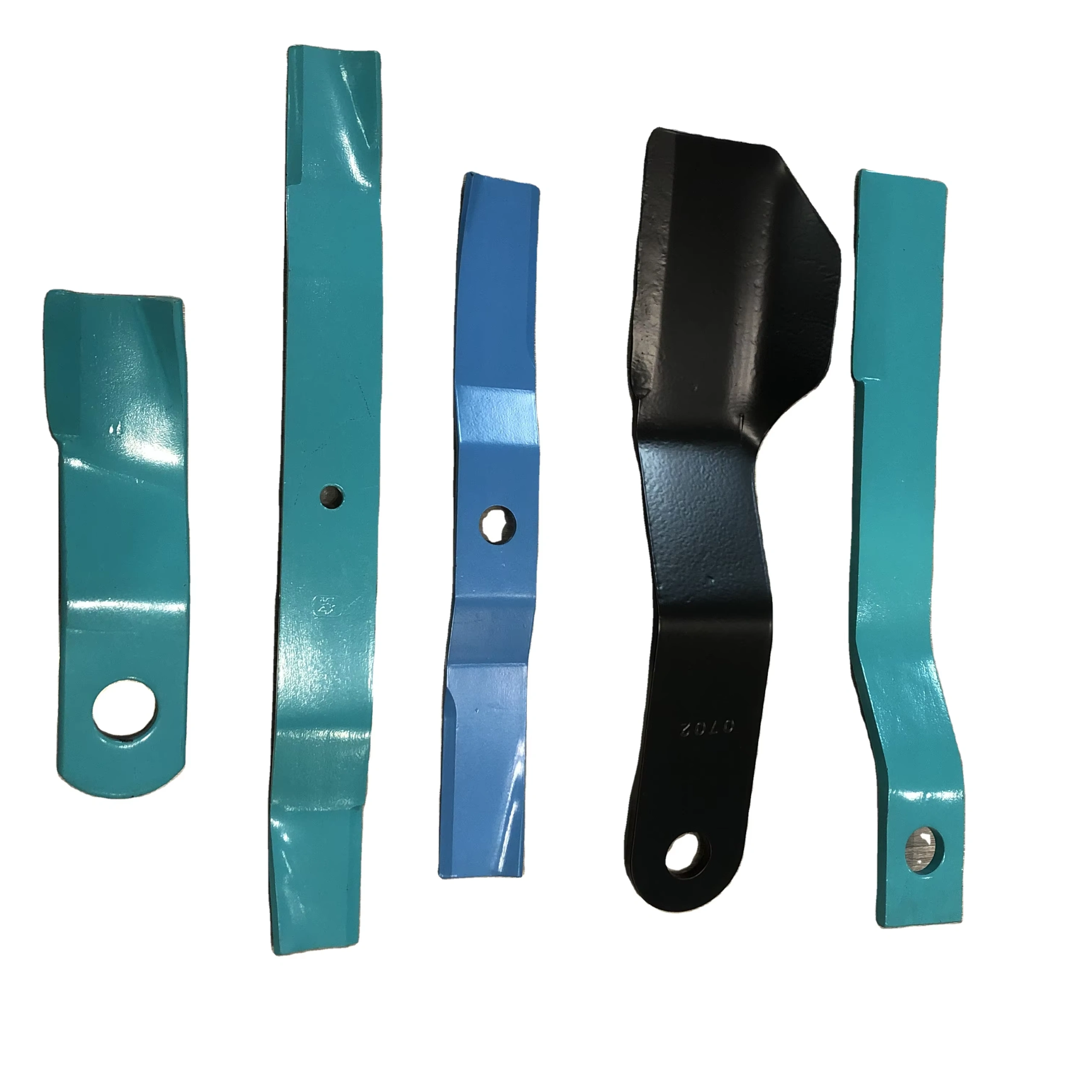
Lawn mower blades are the core working part of any mower, directly affecting cutting efficiency, lawn flatness and the service life of your whole mower. Whether you are supplying blades for small household lawn mowers or commercial heavy-duty mowing equipment, choosing high-quality blades can greatly reduce after-sales costs and improve end-user satisfaction.
Common Types of Lawn Mower Blades
Lawn mower blades are designed differently for different mowing scenarios and functions:
- Straight standard lawn mower blades
The most common entry-level blade, with a simple straight structure and low manufacturing cost. It is suitable for small push-type household lawn mowers, mainly used for routine mowing of ordinary small courtyards, and the price is affordable. - High-lift blades
Designed with a curved wing shape at both ends, it can generate greater airflow to transport grass clippings to the grass bag, and is very suitable for bagging lawn collection. It is also widely used on riding lawn mowers, which can keep the lawn clean after mowing. - Mulching blades (gator mulching blades)
With multiple cutting edges and special serrated designs, it can cut grass clippings into fine pieces directly and decompose them back to the lawn as natural fertilizer, eliminating the need for cleaning grass clippings, which is very popular in environmentally friendly lawn maintenance. - Toothed edging blades
One side of the blade is designed with teeth, which can easily cut through small weeds, shrubs and rough overgrown grass, suitable for uncultivated wasteland and road edge weeding operations, with stronger cutting penetration.
Key Material Selection
The durability of the blade is closely related to the material:
- Carbon steel
The most common material for standard blades, low cost, suitable for household low-frequency use. It can meet the conventional mowing needs, but it is easy to wear and needs to be replaced regularly. - Alloy steel (medium carbon alloy)
After heat treatment, it has higher hardness and better toughness, the blade keeps sharp for a longer time, and it is not easy to deform when impacted, it is the mainstream material for commercial grade blades, and cost performance is very high. - Hardened steel blades
Through special quenching treatment, the surface hardness is greatly improved, the wear resistance is far higher than that of ordinary carbon steel, and the service life can be more than 2-3 times that of ordinary blades, which is suitable for commercial high-frequency mowing operations. Although the price is higher, the overall cost of long-term use is lower.
Daily Maintenance Skills
Correct maintenance can double the service life of the blade:
- Clean after use: Clean the grass residue and soil adhered to the blade in time after each mowing to avoid the corrosion of rotting plants on the blade.
- Sharpen regularly: After working for a period of time, the blade will become dull. You can use a file or grinder to sharpen the cutting edge, which can restore the sharpness and avoid increasing the load on the mower.
- Check balance: After sharpening, you need to check the balance of the blade. Unbalanced blades will cause the mower to vibrate greatly, which will damage the engine bearing for a long time.
- Pay attention to safety: When cleaning and disassembling the blade, be sure to turn off the engine and pull out the spark plug to avoid accidental starting and injury.
Hebei Geoscope International Trade Co., Ltd. produces full specifications of lawn mower blades for various models, covering all types from household small blades to heavy commercial mowing blades. We support customized sizes, LOGO printing and OEM services. All blades are made of qualified alloy steel after strict heat treatment, with uniform hardness and wear resistance, which can adapt to different mowing needs around the world.
If you need bulk procurement of lawn mower blades or have customized requirements, welcome to contact us to get the full product catalog and quotation!